
The tide shrinks along the rugged coastline of Montara, California, quietly pulling back its saltwater curtains and revealing its precious treasures. Five ochre sea stars congregate between swathes of black mussels. Their slick mauve and amber bodies shimmer like gemstones clinging to the earth. Bright, colorful, and resilient; these creatures are the descendants and survivors of a near-apocalypse.
When Stars Fell
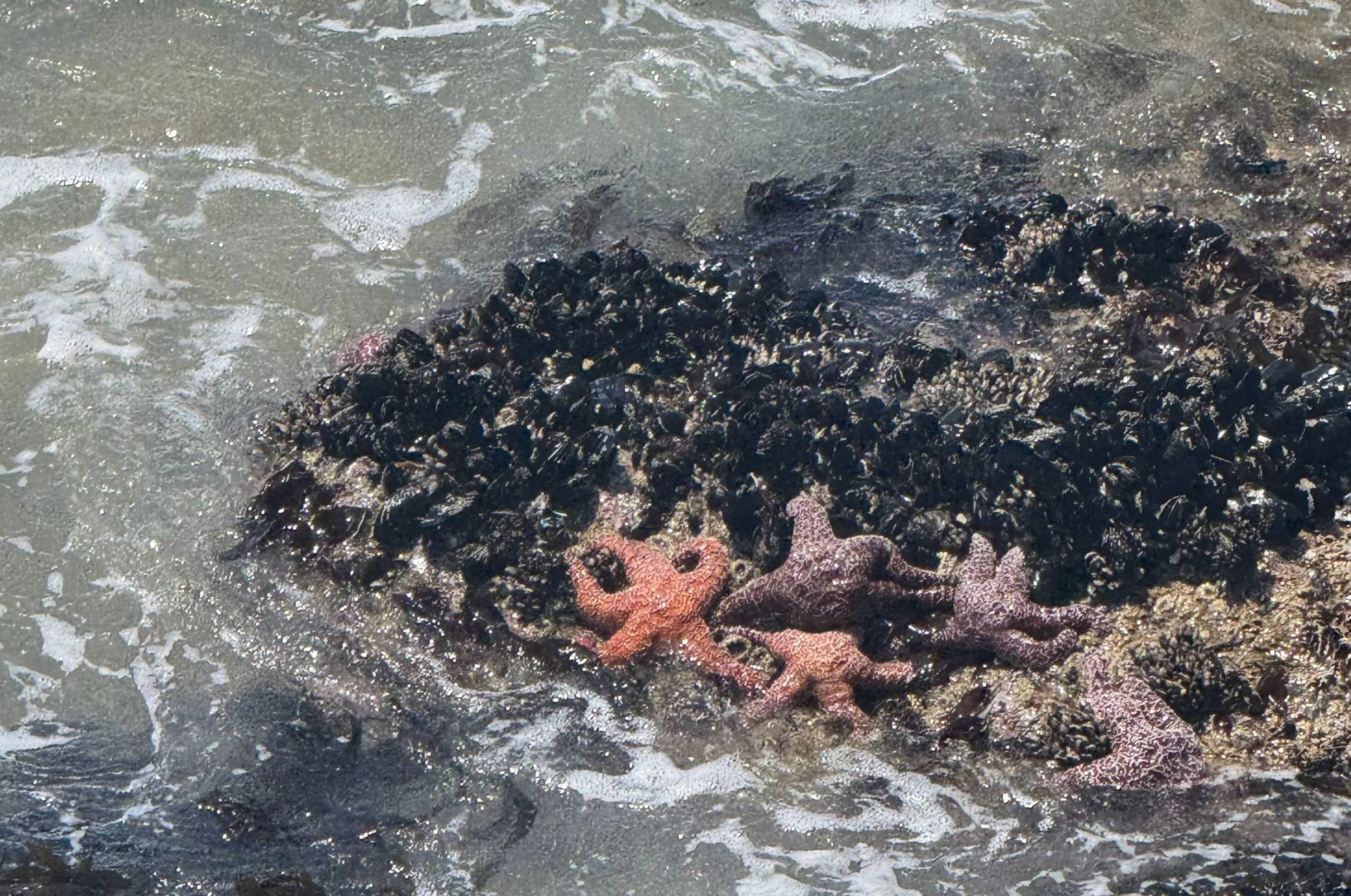
Photo Credit: Rosa Gil
In the summer of 2013, Sea Star Wasting Disease (SSWD) rippled a massive wave of sea star die-offs across North America’s Western coastline. The symptoms were grisly. Infected asteroids became freeze frames of an explosion caught on tape, their deflated bodies punched through by white lesions and organ-oozing gouges. Wastelands and ghost towns replaced the stars’ intertidal habitats as they lost billions–over 90%, in some species– of their inhabitants.
The cause of such a devastating illness has been surprisingly cryptic. Over a decade after the beginning of the outbreak, research from the Hakai Institute in British Columbia recently isolated a strain of the bacteria Vibrio pectenicida as a causative agent of SSWD in sunflower stars. The bacteria, a close genetic relative of species causing cholera and flesh-eating infections in humans, is relatively new to science. V. pectenicida has yet to be tested as a direct cause of SSWD in any of the over 20 other species affected.
Other species in the Vibrio family multiply well in warmer waters, but without data on the geographic distribution of V. pectenicida, it’s difficult to understand where and how the species thrives. Researchers have observed more intense die-offs and slower population recoveries in Southern California compared to cooler Northern waters, but the timelines of mortality spikes and marine heat waves don't quite align. In fact, some sea star populations in Oregon were hit hardest following periods of cooler-than-average sea surface temperatures. It may well be that temperature changes don’t directly effect a population’s initial vulnerability to the bacteria, but aggravate the impacts of the pathogen.
Since that initial year of onslaught, infection rates have receded to chronic background levels between 2-4%. Recent knowledge may help explain why some stars have regained their places in tidal troves along the San Francisco-Monterey
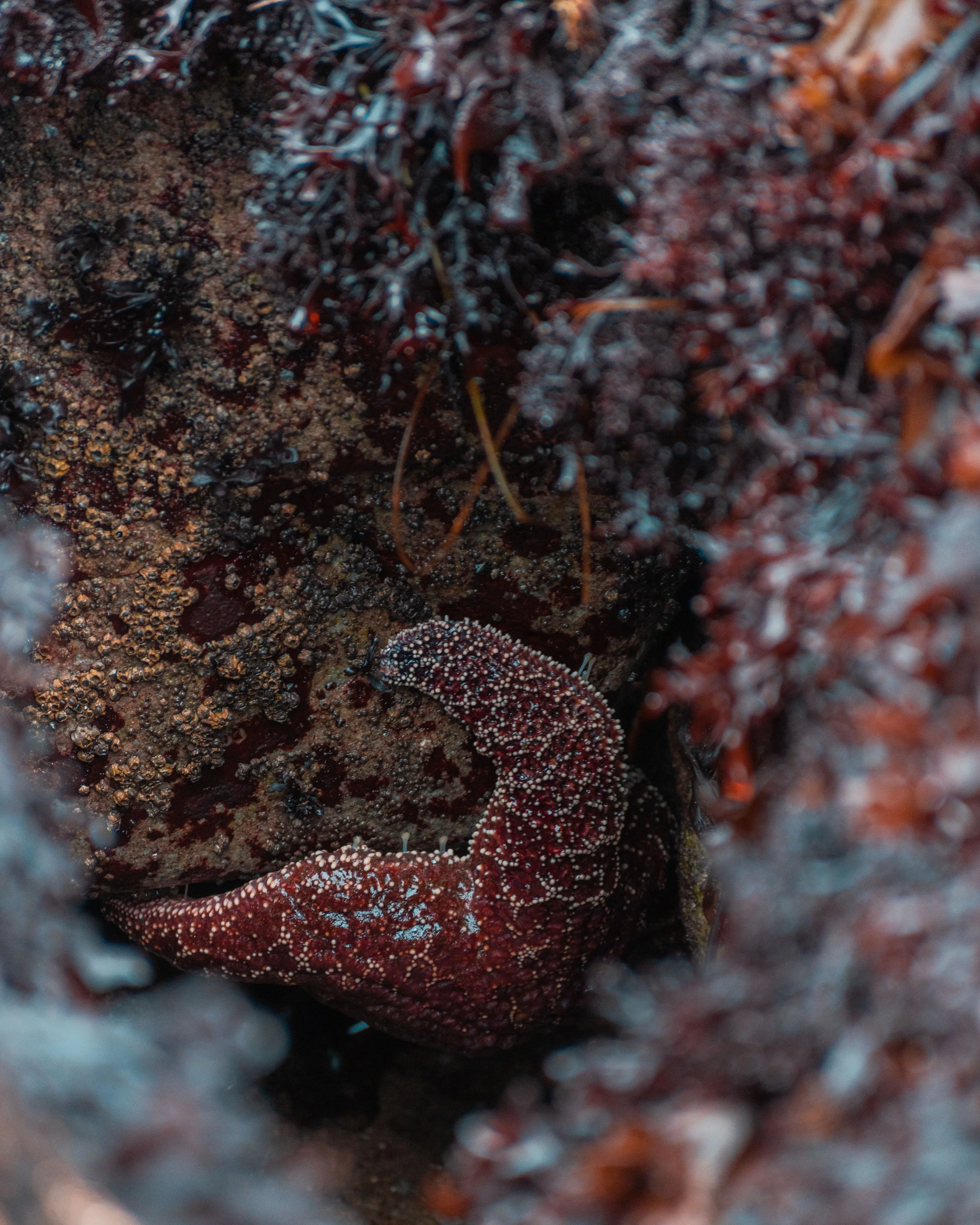
Photo Credit: Abigail Sylvester
On Ochre Stars
The tidepool in Montara offers an opportunity to observe one of the most crucial species for California’s coastline, and one of two sea stars most heavily impacted by Sea Star Wasting Disease. Found widely throughout California, ochre sea stars manage the diversity of tidal ecosystems by keeping their prey, mussels, from claiming too much space on rock formations. The stars can populate tidal zones in dense aggregations, reach sexual maturity at around five years old, and spawn in the spring or summer.
It only took two years for nearly all ochre stars on the west coast to disappear. Populations of ochre stars in Oregon lost between 59 and 84% of their pre- SSWD density, while sites sampled above the San Francisco bay lost from 9 to 81% of their total population between 2013 and 2015. Overall, the northern half of the stars’ range saw at least a 75% decrease in population density at nearly all sampled sites, with some of the most severe disappearances observed in and around the San Francisco bay. Regional differences in the magnitude of these losses don’t appear related to the stars’ densities within their populations; stars could still transmit the illness from far apart.
The Recovery Generation
At most northern sites, these bludgeoning losses were followed by monumentally large reproduction events. Surveys along the coast during the years following the outbreak reported 7,400% increases in young sea stars in Northern California and an average 8,100% increase among Oregon sites.
The mass- settlements of young sea stars, called ‘recruitment pulses’, flipped the population pyramid on its head. Most new recruits don’t normally stand a chance against their elders; as inheritors of their parents’ barren landscapes, the small stars likely thrived without competition from older individuals for resources. Despite their numbers, the new generations couldn’t make much of a dent in the resurgent mussels, which had capitalized on the sudden absence of one of their predators. Despite overshooting their pre-SSWD numbers at many northern populations, the ochre sea stars bear the burden of rebuilding top-down control of their prey and regaining stability in a post-apocalyptic landscape.
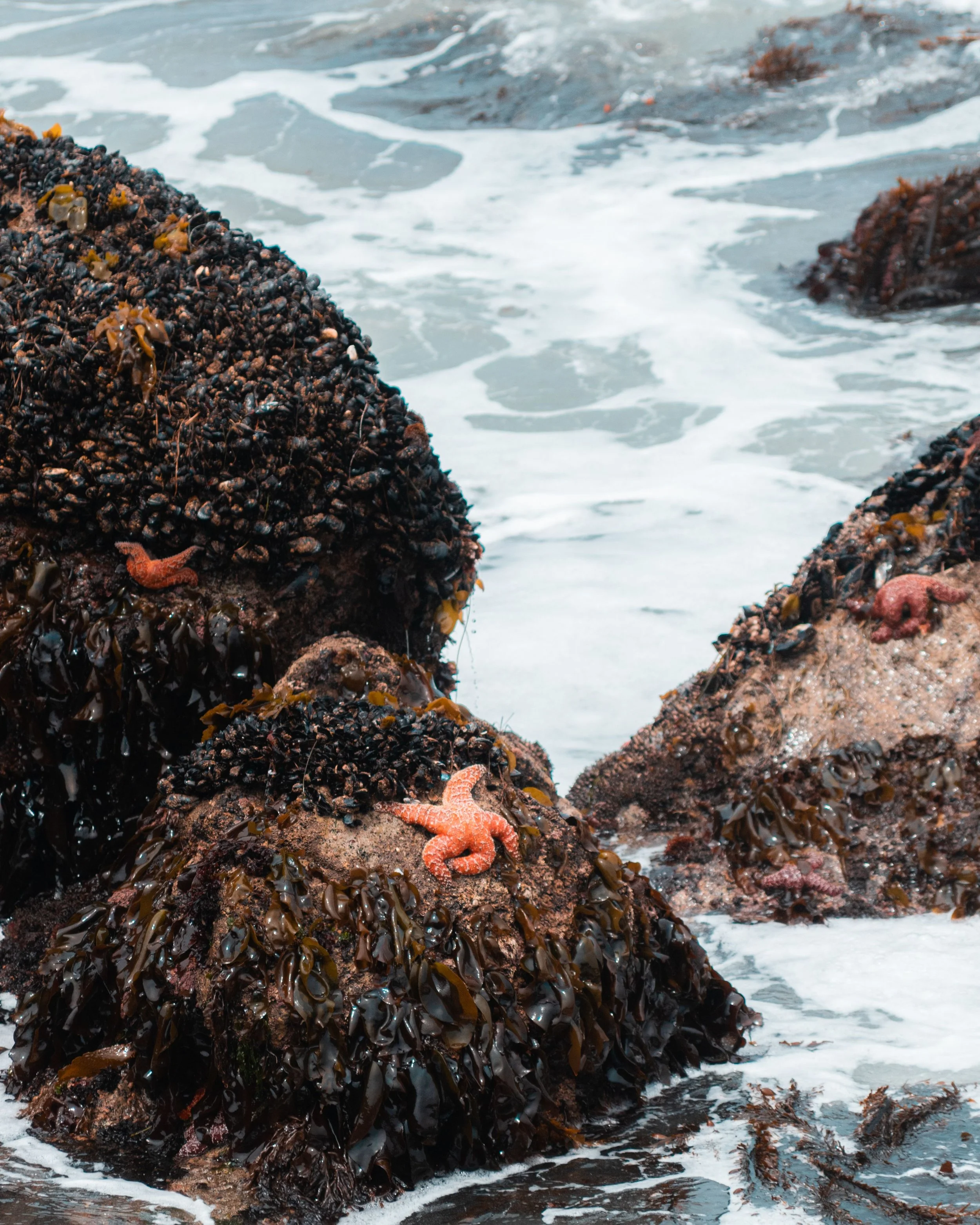
Photo Credit: Abigail Sylvester
A Genetic Edge
Scientists wondered wether survivors of the epidemic carried resistance in their genes. After sequencing the genomes of pre-disease adults, post-disease adults, and new recruits, researchers at UC Merced determined that young and established ochre stars surviving in the years after 2013 had a significant, unilateral shift in their DNA compared to the pre-SSWD generation. Sea Star Wasting Disease had induced a bout of natural selection on the ochre star, sparing more resistant survivors. These survivors had passed this resistance on to the new recruits.
The survivor stars also appeared to maintain a high degree of genetic variation relative to the pre-disease population, a hallmark of healthy, resilient generations. Despite their losses, a large, diverse population exists, providing the blueprints needed for the stars to adapt.
On Sunflower Stars
Back in Montara, another species is notably absent from the seaside gallery. The sunflower sea star, once widespread throughout the west coast, lost over 90% of its total population during the outbreak. These four foot wide, 24-armed goliaths served as the formidable guardians of California’s kelp forests, defending their ecosystems from the cascading effects of sea urchin overpopulation. Without predation pressure from sunflower stars, urchins overgraze the kelp, deconstructing their ecosystem into an evacuated water column and a barren seafloor– another wasteland altogether.
Without the booming and busting recruitment episodes of the ochre star, sunflower stars have been slow to recover. The species showed symptoms before any other when Sea Star Wasting Disease arrived in a community and has become functionally extinct south of Monterey. Evidence from star populations in Washington suggests that sunflower stars may be sensitive to seasonal flare-ups in the disease during the Fall and Winter. The International Union for the Conservation of Nature declared sunflower stars Critically Endangered in 2021.
Rescuing a Giant
With billions of individuals stripped from the breeding population, the potential for a spontaneous recovery in the wild is unlikely. Aquarists and scientists have set to work on solving the problem of sunflower sea star immunity; one group hopes to breed immune stars, while the other looks to their environment for answers.
In San Francisco, researchers at California Academy of Sciences have begun working with partners like The Nature Conservancy and the National Oceanic and Atmospheric Administration to develop a breeding program for sunflower sea stars. Like those found in ochre stars, the researchers hope to uncover resistance-favoring genes in the sunflower stars’ DNA, with an eventual goal of re-introducing immune individuals into the wild. In the short term, their plan includes breeding and distributing sunflower stars to research facilities and aquariums nationwide, spreading public awareness and building up a reserve population.
Further up the coast, researchers from the University of Washington have turned their attention to the disease-causing bacteria itself in search of answers. The team has begun tinkering with the interaction between water temperature and bacterial concentration in the hope of finding a tolerable threshold for the sunflower stars, as well as surveying the west coast for areas of particularly high bacterial concentration. As this research develops, collaborative efforts between organizations may learn more about possible tools to use to attack the bacteria or mitigate its impacts on wild stars.
The improbable is also not impossible; communities of sunflower stars have recently been sighted by scientific divers and the eagle- eyed public, raising questions about the possibility of an undiscovered immune population.
Outlooks on an Outbreak
Seven years before the COVID-19 pandemic, sea stars fell off of the west coast in droves. Disease ecology skyrocketed to the front of public concern in 2020, bringing with it the recognition of mass-infections as serious threats to the wellbeing of humans and animals. As researchers launch collaborative efforts investigating the interplay of temperature, population density, and genetic variation on the survival of sea stars, their findings have the potential to inform collective knowledge beyond tide pools and kelp forests.
Citizen scientists have the opportunity to participate and aid these foundational research efforts by logging any sea stars they find in databases like UC Santa Cruz’s Multi- Agency Rocky Intertidal Network and iNaturalist. Organizations like California Academy of Sciences also host volunteer survey events.
Resources
Dunagan, Christopher. (2025, October 13). With One Mystery Solved, Researchers Examine
New Strategies for Sea Star Recovery. Salish Sea Currents Magazine. www.eopugetsound.org/article/one-mystery-solved-researchers-examine-new-strategies-sea-star-recovery
Gravem, S. A., & Menge, B. A. (2025). Metapopulation-scale resilience to disease-induced mass
mortality in a keystone predator: From stasis to instability. Ecosphere, 16(10). https://doi.org/10.1002/ecs2.70426
Miner, C. M., Burnaford, J. L., Ambrose, R. F., Antrim, L., Bohlmann, H., Blanchette, C. A.,
Engle, J. M., Fradkin, S. C., Gaddam, R., Harley, C. D. G., Miner, B. G., Murray, S. N., Smith, J. R., Whitaker, S. G., & Raimondi, P. T. (2018). Large-scale impacts of sea star wasting disease (SSWD) on intertidal sea stars and implications for recovery. PLoS ONE, 13(3). https://doi.org/10.1371/journal.pone.0192870
Prentice, M. B., Crandall, G. A., Chan, A. M., Davis, K. M., Hershberger, P. K., Finke, J. F.,
Hodin, J., McCracken, A., Kellogg, C. T. E., Clemente-Carvalho, R. B. G., Prentice, C., Zhong, K. X., Harvell, C. D., Suttle, C. A., & Gehman, A. L. M. (2025). Vibrio pectenicida strain FHCF-3 is a causative agent of sea star wasting disease. Nature Ecology and Evolution, 9(9), 1739–1751. https://doi.org/10.1038/s41559-025-02797-2
Schiebelhut, L. M., Puritz, J. B., & Dawson, M. N. (2018). Decimation by sea star wasting disease
and rapid genetic change in a keystone species, Pisaster ochraceus. PNAS, 115(27), 7069–7074. https://doi.org/10.6071/M3WW84
Amazing Species: Sunflower Sea Star. (2021). The IUCN Red List of Threatened Species.
Ochre Sea Star. (n.d.). Marine Species Report Card.
www.aquariumofpacific.org/reportcard/info/ochre_sea_star
Sea star wasting disease. (2026, April 21). Multi-Agency Rocky Intertidal Network.
marine.ucsc.edu/research/sea-star-wasting/
Sunflower sea stars. (n.d.). California Academy of Sciences.
www.calacademy.org/about-us/sustainability-in-action/breeding-programs/sunflower-sea-stars